 The Wellbeing Notebook

If you wake up stiff. If your shoulders ache before your feet even touch the floor. If some mornings your husband has to help you button a blouse you’ve worn a hundred times, you already know this isn’t in your head.
You also know what most doctors say. It’s stress. It’s hormones. It’s just getting older. They give you something for the pain, something for the sleep, something for the anxiety that comes from not sleeping. The bottle stack grows. The pain doesn’t leave. It just gets quieter, then louder, then quieter again. This is the story of a 58-year-old in Texas named Linda who spent eight years being told some version of that, and the one rheumatologist who finally explained what no one else had.
First, the thing she waited eight years to hear
Let’s say it out loud, the thing Linda waited years to hear from someone in a white coat: your pain is real. It is not in your head, you are not exaggerating, and you are not a complainer for wanting your life back. She raised two kids, never missed a thing. So when the tests kept coming back “normal,” the worst part wasn’t the pain. It was the look, the quiet suggestion she was making too much of it. If that is you too, take a breath. This page is not going to do that to you.
How long have you been dealing with this?
“It started in my shoulders. Now it’s everywhere.”
Linda’s pain began the way it begins for almost everyone: a deep ache in one shoulder that wouldn’t quit. Within a year it was in both shoulders, her hands, her hips, her lower back, what one doctor called “widespread musculoskeletal pain of unclear origin,” the polite phrase for we don’t really know.
She tried physical therapy. A low-dose antidepressant prescribed off-label. Gabapentin. Cutting gluten, then sugar, then nightshades. A full drawer of supplements that promised “joint support.” Each one helped for a few weeks. Each one stopped. So if part of you is already thinking here we go again, Linda would not blame you. That reflex is not pessimism, it is evidence; you earned it. But notice what every one of them had in common: they chased the pain after it showed up. None asked the question underneath it.
What every other doctor missed
Linda’s rheumatologist, twenty years in practice, was the first to ask a different question. He pressed gently on the small joints of her hand and said:
“How long has your body not been able to put this inflammation out? Because that is what I am looking at. This is not a disease lighting new fires. It is inflammation your body has slowly lost the ability to calm on its own.”

Then he explained something Linda had never heard in eight years of appointments. Inside every cell is a molecule called glutathione, what doctors call the body’s “master antioxidant,” the one that recycles vitamin C and E and keeps oxidative stress in check from the inside out.* And here is the part no one had told her. The body makes less of it with age. Research finds we lose roughly 20 to 40 percent of our glutathione by our sixties and seventies, and more than half of adults aged 60 to 80 are running critically low.* When that happens, the body has a harder time keeping up. The very fatigue Linda had been told was “just stress” was, in her doctor’s words, what a body running low on its own master antioxidant looks like.*
The McGill discovery most doctors still don’t know about
Why isn’t glutathione a household word? Biology. You can’t take it as a pill. Your gut breaks it down before it reaches the cells that need it. For decades scientists tried to raise it safely, and failed.
Then in the late 1970s, a researcher at McGill University in Montreal named Dr. Gustavo Bounous noticed something about a specific undenatured whey protein, cold-processed to preserve a fragile compound called bonded cysteine, the rate-limiting building block the body uses to make its own glutathione. His lab spent the next twenty years proving it. Today there are over 150,000 published papers on glutathione, more than 50,000 in the last decade. In Bounous’s own animal work, the mice given the whey isolate lived about 30 percent longer than the controls. The refined product is called Immunocal.
And it is not some fringe product, either. Immunocal is one of the very few supplements listed in the Physicians’ Desk Reference, the PDR, the drug-reference book physicians across the United States keep on their shelves and trust, where it is classified as a nutraceutical: a natural product studied for real, beneficial effects on the body, not merely its nutrition.
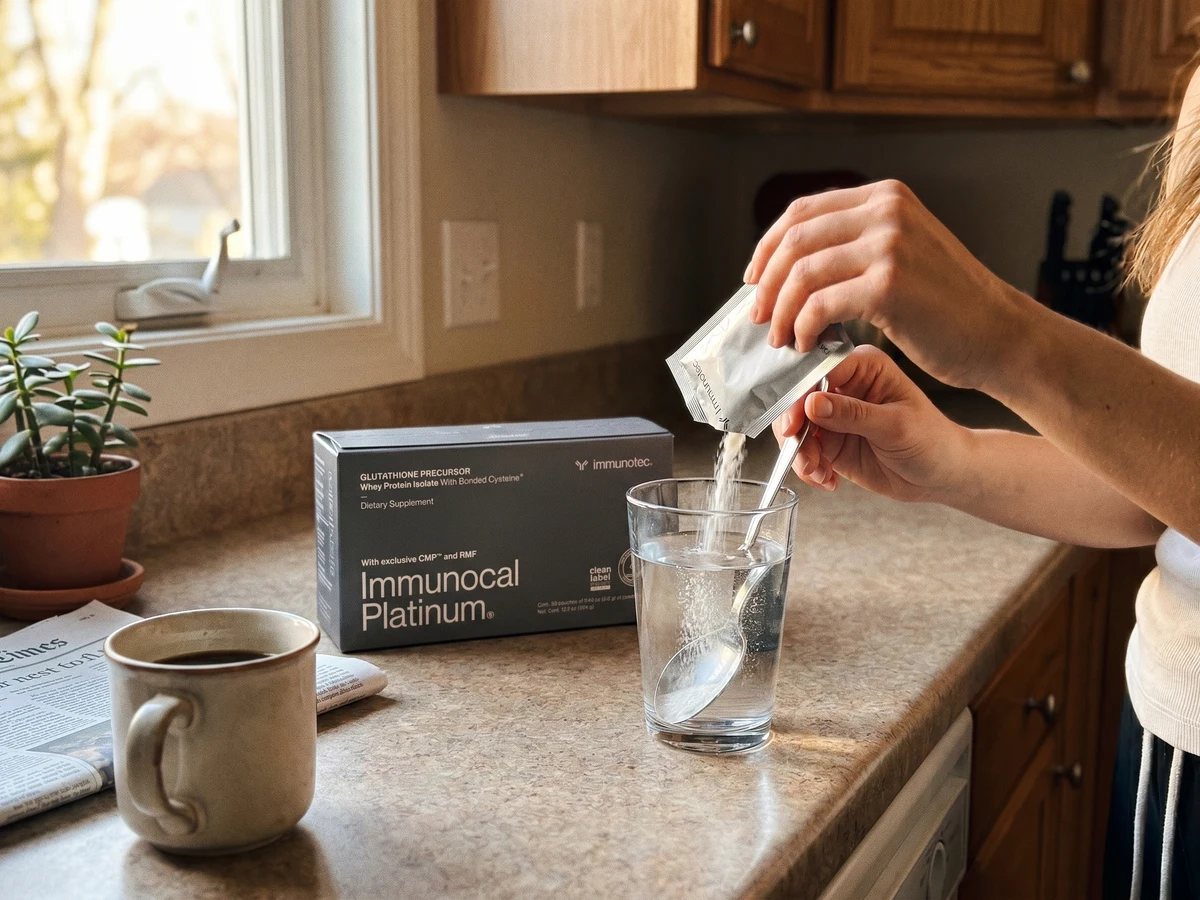
Immunocal, a glutathione precursor, not a glutathione pill
It’s a flavorless powder in single-serve sachets. You stir it into water. It doesn’t replace anything in your medicine cabinet. It gives your body the raw material to make more of its own master antioxidant.*
- Patented Bonded Cysteine®, a delivery form shown to survive stomach acid and support the body’s own glutathione production*
- 40+ years of research originating at McGill University, with 100+ published papers
- Listed in the Physicians’ Desk Reference (PDR), the U.S. physician drug reference, as a nutraceutical
- Clean Label Project Purity Award, independently tested for 200+ contaminants
- CMP™ whey isolate, cold-processed to keep fragile peptides intact
- Used by physicians, athletes and integrative practitioners in 8 countries
Linda’s first ninety days
Her doctor’s protocol was simple, and it matched what Immunocal’s clinical advisory has told practitioners for years: four sachets a day, for three months. By week three, Linda was sleeping through the night for the first time since 2022. By week six, the morning stiffness was, in her words, “still there, but it doesn’t run the day anymore.” By the end of month three she was dressing herself, walking with her husband in the evenings, and using less than half the pain medication she’d started with.
“This is what your body looks like when it finally has the raw material it’s been missing,” said Linda’s rheumatologist at her three-month follow-up.
She isn’t a special case. She’s the typical case for women her age who finally find a specialist willing to look at the upstream cause instead of treating each symptom in isolation.



Reader Comments (47)
I sent this to my mom. She’s been dealing with the exact same thing for years and no one ever explained the glutathione angle to her. Bookmarking for her appointment next week.
I’ve been on the four-a-day routine for about five months. The first two weeks I didn’t notice anything and almost quit. Week three something shifted. I’m not pain-free, but I’m functional in a way I haven’t been since my early fifties.
My naturopath has been recommending this for two years. The people who stick with it for the full three months almost always come back better. The ones who quit at week two because they “don’t feel anything” never give it the chance it needs.
Thank you for writing about this. I’ve been asking my GP about glutathione for three years and he kept brushing me off. I’m going to print this and bring it to my next appointment.
The McGill research is what convinced me. Forty-plus years and that many published papers is not nothing. I used the chat to figure out which routine fit my situation and started eight weeks ago. Sleep is the first thing that came back.